


🎁How to start a personalised gifts business with a profitable catalogue
🎁How to start a personalised gifts business with a profitable catalogue
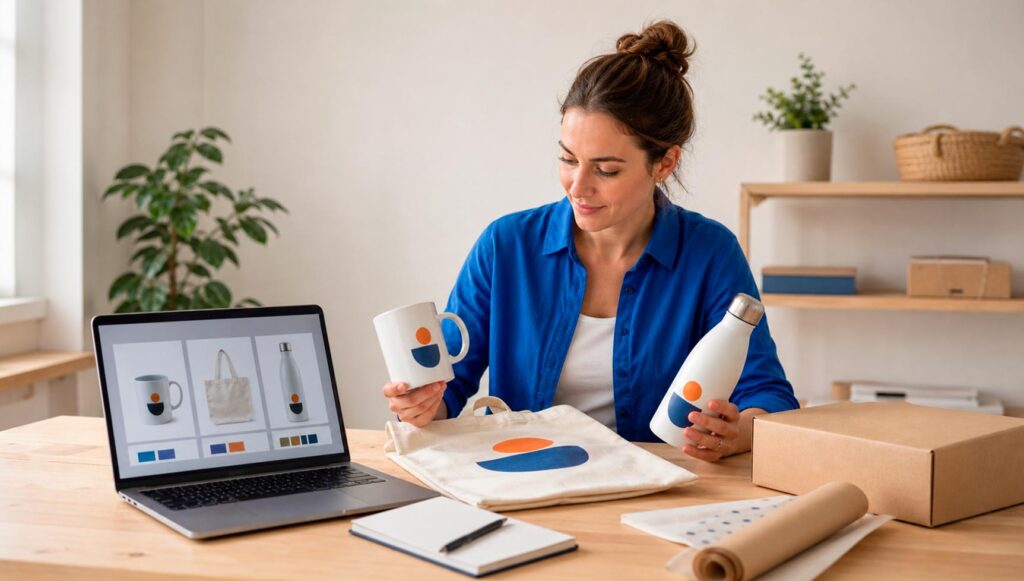
Starting a personalised gifts business may seem simple: you choose some products, buy a machine, publish your designs, and wait for the orders to come in.
However, there is a much safer way to start: first decide what you are going to sell, to whom, and with what margin. The machinery, technique, and catalogue size should come afterwards.
In this guide, we help you create a small yet coherent initial catalogue, calculate whether your products can be profitable, and ensure there is interest before making a significant investment.
ÍNDICE
- Before choosing products, choose your customer
- Start with just three products
- Calculate the actual cost of each product
- Check if someone would buy your products
- Produce Yourself or Outsource?
- Select the technique based on the product
- Avoid these mistakes when starting
- Start small, but with a clear idea
Before choosing products, choose your customer
One of the most common mistakes when starting out is trying to sell gifts for everyone: mugs for couples, t-shirts for hen and stag parties, wedding favours, pet products, corporate gifts…
Although technically you can customize all those items, bringing them together in one store does not mean they make an attractive catalogue.
It is easier to differentiate yourself if you start by considering a specific type of customer or a particular need:
- Families looking for gifts for special occasions
- Couples and wedding or event planners
- Small businesses that need merchandising
- Schools, associations, and sports clubs
- People looking for customised products for their pets
- Companies that prepare gifts for employees or clients
- Tourists who want to take home a unique souvenir
- Creators and small brands that want to sell their designs
You don't have to limit yourself to one of these audiences forever. It's about choosing a starting point that allows you to clearly communicate what you do and why someone should buy from you.
It is not the same to present yourself as "a store of personalized products" as it is to present yourself as "a brand specializing in gifts for animal lovers." The second proposal is much easier to remember.
Start with just three products
Having a very extensive catalogue can convey variety, but it also means purchasing more materials, preparing more designs, learning different processes, and maintaining a larger stock.
To begin with, we propose creating a minimum catalogue of three products.
An entry-level product
A main product
A pack
It should be easy to understand, relatively affordable, and simple to customise. It can help you secure your first orders and showcase your work.
Some examples are tote bags, keyrings, badges, tags, magnets or small personalised plaques.
It will be the most prominent item in your catalogue. It must represent your style well and offer a higher perceived value.
It could be a sweatshirt, an illustrated cushion, a bottle, an event sign, or an engraved decorative piece.
The third product can be a combination of the two previous ones or a set prepared for a specific occasion.
Packs simplify customer choice, increase the average order value, and allow the product to be presented as a complete solution.
For example:
| Audience | Input product | Main Product | Pack |
| Pets | Identification tag | Cushion with illustration | Welcome pack |
| Weddings | Name tags | Welcome sign | Stationery and decoration pack |
| Sports clubs | Personalised bottle | Team sweatshirt | Equipment for players |
| Families | Photo keychain | Cushion or print | Birthday pack |
| Local businesses | Stickers with logo | Personalised workwear | Identity pack for the team |
Calculate the actual cost of each product
The price of the non-customised item is only part of the cost. To determine if a product can be profitable, you must consider everything necessary to prepare and deliver the order.
Include at least:
- The item you are going to personalise
- Consumables: ink, paper, vinyl, thread, film, adhesives…
- The packaging
- The design time
- The preparation of files and machines
- Production time
- The attention and the changes requested by the client
- Failed tests and potential waste
- A proportional part of your fixed expenses
- The store or payment platform commissions
- The margin you need to achieve
Your time is also part of the cost. Even if you start working from home, you shouldn't consider the hours spent designing, talking to the client, producing, and preparing the package as free.
It is also important to record errors. If approximately one in every twenty units needs to be repeated, that loss must be accounted for in the price of the others.
You don't need to use a complicated formula. The important thing is to avoid pricing based solely on what the competition charges or simply doubling the product cost.
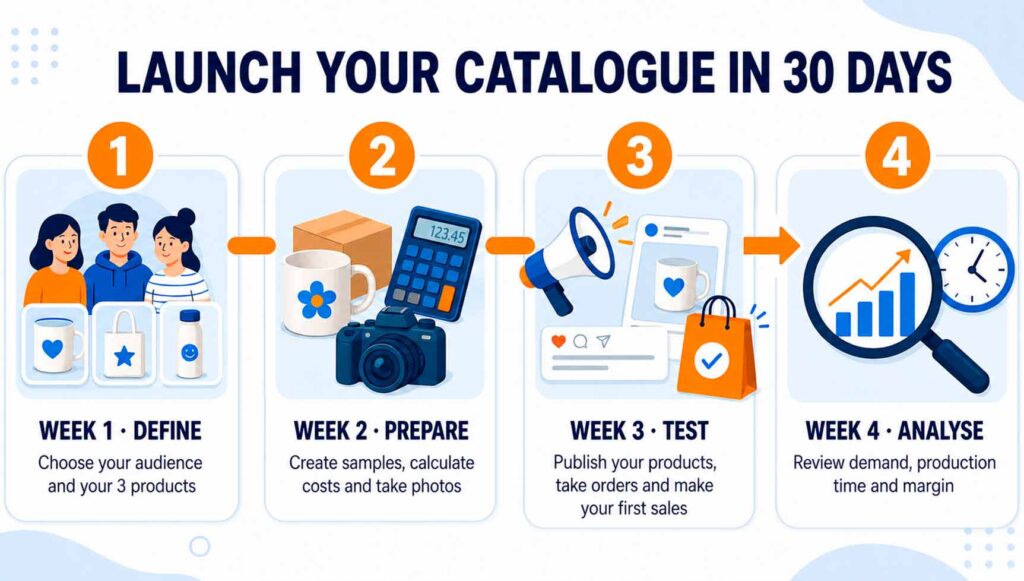
Check if someone would buy your products
Researching trends and observing the competition can provide you with good insights, but the most useful indicator is securing actual orders.
To test your initial catalogue, you can:
- Create a sample of each product
- Prepare photographs or realistic simulations
- Show them to the type of client you want to target.
- Publish a limited-time offer or open a pre-sale
- Record which product receives inquiries and which generates orders
- Note the questions and objections of the buyers.
The "likes" and positive comments are encouraging, but they do not equate to a sale. Try to secure some paid orders, even if they are few, as they will allow you to test the entire process.
During these initial sales, you will discover issues that don't appear on paper: how long it takes for the customer to send a valid photograph, how many changes they request, how much time you spend on packaging, or whether the product withstands transportation well.
This information will help you adjust the price and decide whether it is worth expanding that line.
Produce Yourself or Outsource?
Starting a customisation business does not necessarily mean purchasing all the machines you might need from day one.
Outsourcing part of the production can be a good option when you are testing a product, receive occasional orders, or do not yet have enough volume to invest in machinery.
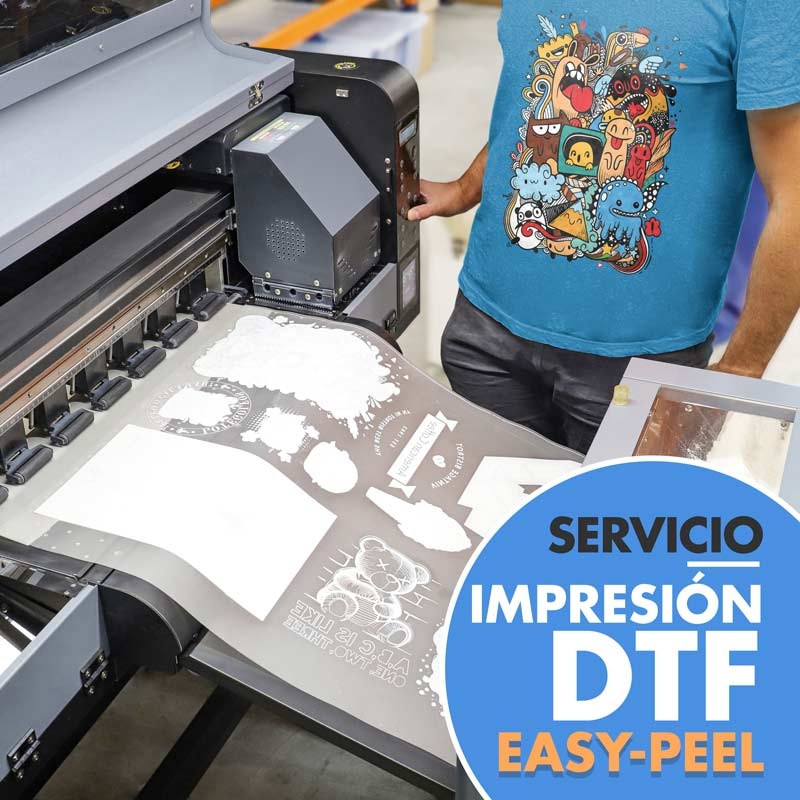
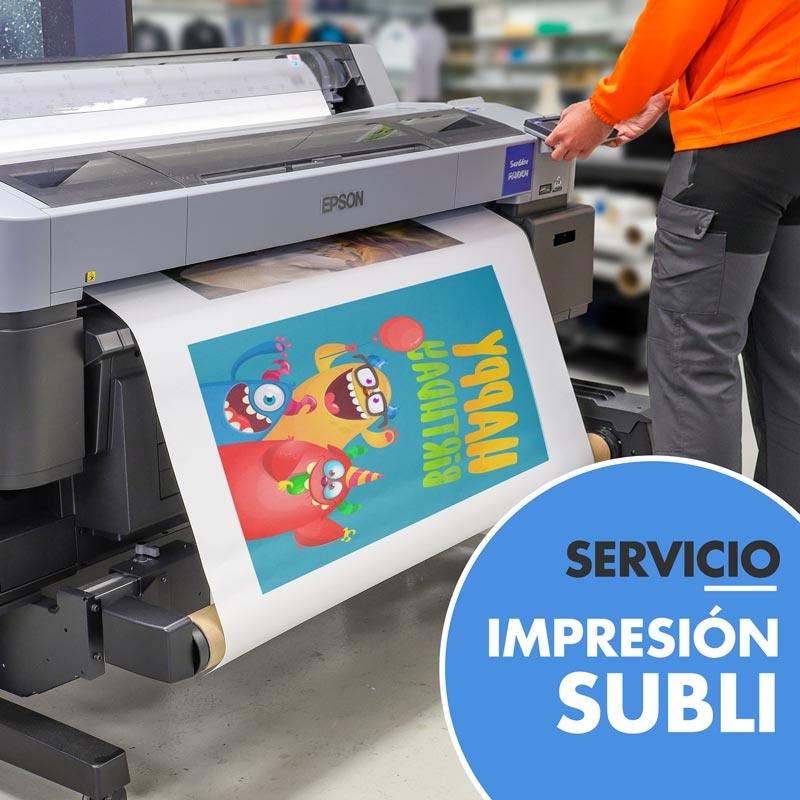
Additionally, you don't always need to have your own printer. You can use the DTF printing service by the metre or the sublimation printing service to receive your designs ready to transfer, allowing you to focus solely on applying them with the appropriate transfer press.
In-house production becomes more appealing when you have recurring orders, are well aware of your margins, and need to control deadlines or the finish.
Before purchasing a machine, ask yourself:
- How many monthly orders will actually use this equipment?
- How much profit does each one bring?
- How many orders will I need to recoup the investment?
- Do I have the space, time, and knowledge to maintain the machine?
- What additional costs will I need to incur?
- Could you try the product in another way first?
The best machine is not necessarily the one that allows you to do more things, but the one that meets a real need in your catalogue.
Select the technique based on the product
Once the catalogue is defined, it will be much easier to know which customisation technique interests you.
Each one has different advantages, limitations, costs, and requirements. If you need to compare them in more detail, check our guide to personalisation techniques.
Do not choose solely because it is trendy or because a machine seems very versatile. Consider what percentage of your catalogue you will be able to produce with it and what volume of work it will handle.
Avoid these mistakes when starting
| Buying too much before selling | A team can open up new possibilities, but it also incurs costs and requires sufficient work to pay off. |
| Creating a Catalogue Without a Defined Audience | A coherent collection is usually more convincing than a wide variety of unrelated items. |
| Competing solely on price | Small businesses can hardly always be the cheapest. They can compete through design, specialisation, service, speed, or presentation. |
| Do not charge for the design work | Preparing files, retouching photographs, and making changes is also work, even if it doesn't involve using materials. |
| Accept any task | Orders that deviate significantly from your usual process can take up a lot of time and leave very little margin. |
| Expanding the catalogue too soon | Before adding a new product, ensure that it enhances your offering and does not merely add more work or stock. |
When should you upgrade?
Your catalogue is ready to expand when:
- You receive recurring orders.
- You know the cost and time of each product.
- You maintain an appropriate margin.
- The clients are requesting a specific extension.
- You can produce without delaying the current orders.
- The new product targets the same audience.
You can expand through new designs, colours, or packs before incorporating completely different items. Often, you don't need ten more products, but rather to make better use of those that already work.
Start small, but with a clear idea
You don't need to start with a large catalogue or have all the customisation techniques. You need a recognisable proposal, a few well-chosen products and prices that allow the project to continue growing.
Choose a client, create three products, calculate their costs, and test the process with real orders. Afterwards, you will have enough information to decide which technique to master, which equipment to incorporate, and where to expand your business.
And if you need help choosing materials, customizable products, or machinery, at Brildor we can advise you to find the option that best fits your project.
What type of personalised gifts would you like to sell? Let us know in the comments. Our team will be delighted to provide you with answers and assistance. You can also contact our Customer Service Department directly for additional help.
Remember that on our social media, we post a wide range of ideas, offers, and the latest news related to various personalisation techniques daily. To stay updated on everything, follow us on Instagram and TikTok. And don't forget to subscribe to our YouTube channel to continue learning with us!
See you in the next post!
👇 Other articles that may be of interest to you:
Turn your inkjet printer into a tool for entrepreneurship
🚀 8 reasons to embark on starting a sublimation business
🛒 How to Sell Personalised Products on Etsy: Step-by-Step Guide to Get Started

🔥 What type of laser do you really need for your business?
WE WANT TO KNOW WHAT YOU THINK
You may also like