


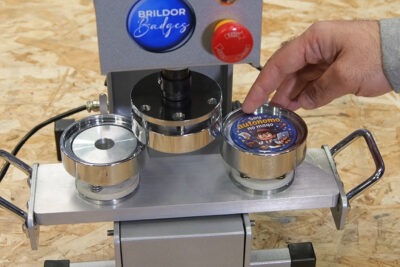
🔧 Maintenance of a manual badge-making machine: how to clean and lubricate it
🔧 Maintenance of a manual badge-making machine: how to clean and lubricate it
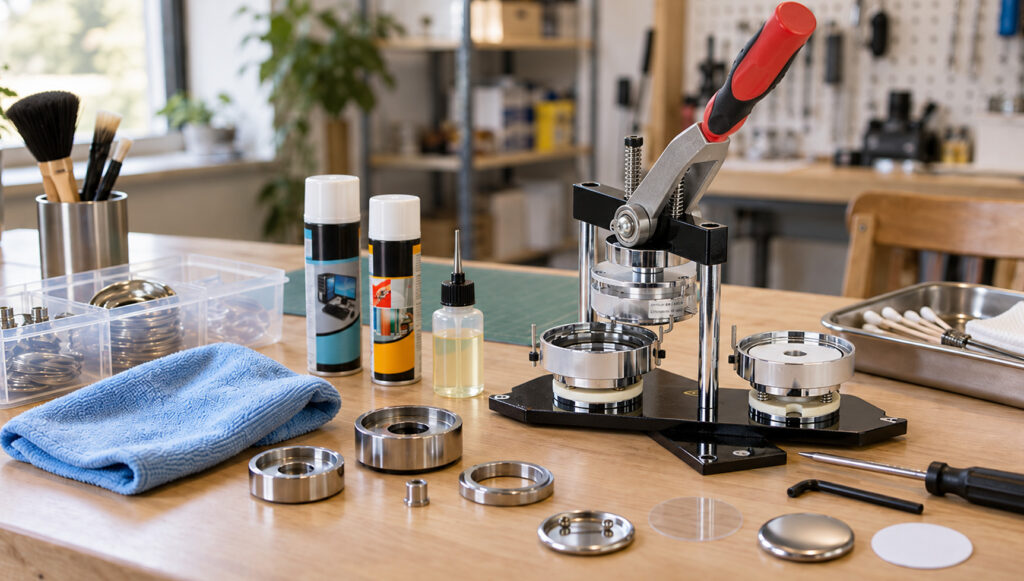
A manual badge-making machine requires minimal maintenance, but it is advisable to clean and check it periodically. Paper, plastic, or dust residues can accumulate in the moulds, and some moving parts may become more resistant with use.
Good maintenance primarily involves keeping the machine clean, checking the condition of its parts, and lubricating only the mechanisms that require it.
We explain how to do it step by step.
ÍNDICE
- What maintenance does a badge-making machine require?
- How to clean a button-making machine
- How to lubricate a button-making machine
- Should the moulds be lubricated?
- How often should maintenance be performed?
- What to check if the badges start coming out poorly
- What to do if the lever is stiffer than usual?
- Conduct a test after maintenance.
- Mistakes to avoid during maintenance
- Proper maintenance extends the lifespan of your machine.
- Frequently asked questions about the maintenance of a badge-making machine
What maintenance does a badge-making machine require?
The manual machines for making badges have a simple operation: they feature a pressure lever, a base or platform for the moulds, and various components that allow the assembly of the badge's front and back.
The main maintenance tasks are:
- Regularly clean the moulds.
- Remove paper, plastic, and dust residues.
- Check the condition of the pressing surfaces.
- Check that the lever and the base move correctly.
- Lubricate certain moving parts when necessary.
- Avoid allowing the lubricant to reach the parts that come into contact with the sheet metal.
It is not necessary to perform a deep cleaning after each use, but it is advisable to prevent residue from accumulating.
1. Remove debris after working
During the assembly of the badges, small remnants of paper, transparent protective film —also known as Mylar— or dust may remain around the moulds. After working, check the machine and remove any visible residue.
You can use:
- A clean, dry cloth.
- A soft brush for accessing narrow areas.
- Compressed air applied carefully when necessary.
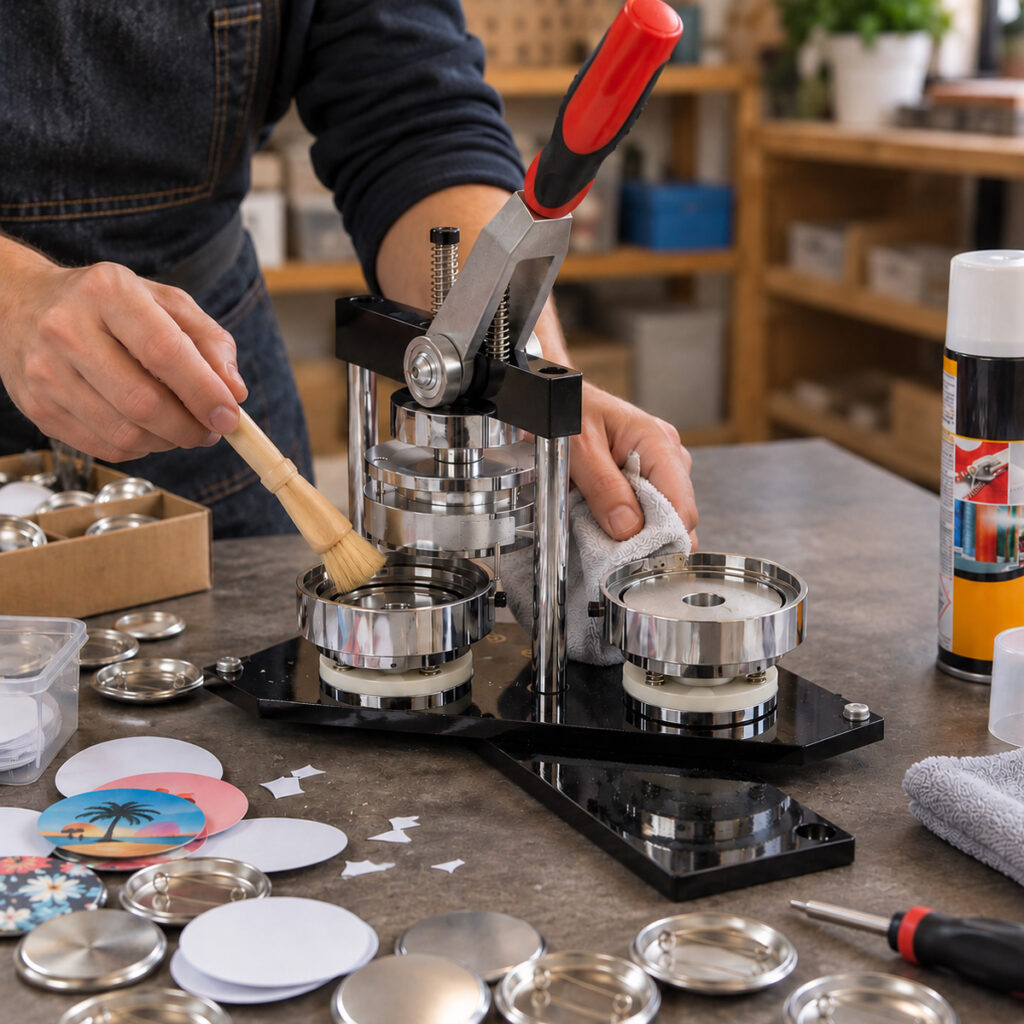
Avoid introducing liquids directly into the mechanisms.
2. Clean the moulds
The moulds play a direct role in the pressing process, so it is particularly important to keep them clean.
If your machine allows you to easily disassemble them:
- Remove them following the usual assembly system.
- Remove any paper or plastic residues.
- Wipe a clean, dry cloth over the accessible surfaces.
- Check that there are no residues on the edges or in the interior areas.
- Reposition them correctly before using the badge-making machine.
Do not use blades, screwdrivers or metallic objects to remove adhered residues. You might scratch or damage the work surfaces.
3. Check the condition of the moulds
Take advantage of the cleaning to visually check that there are no adhered residues, dents, burrs, rust, deep scratches, or deformations.
The moulds need to fit correctly to close the sheet metal evenly. If a surface is damaged or deformed, it can affect the final result.
In that case, avoid modifying or sanding it on your own if you do not have specific instructions to do so.
4. Also clean the base and the structure
Do not focus all maintenance solely on the moulds. Also remove dust and debris from the base, the rotating or sliding platform, the mould housing, the lever area, visible joints, and accessible shafts.
You can use a clean cloth. If you slightly dampen it to clean any exterior area, ensure that the badge-making machine is completely dry before using it again.
With continuous use, friction between some moving parts may increase. Lubrication helps mechanisms move more smoothly and reduces friction between surfaces.
For this purpose, a silicone spray lubricant can be used, such as Extra Silicone Spray.
Its function in this maintenance is to facilitate the movement of moving parts and reduce friction. It should not be used as a substitute for cleaning.
It can be applied, in small quantities, to moving parts such as:
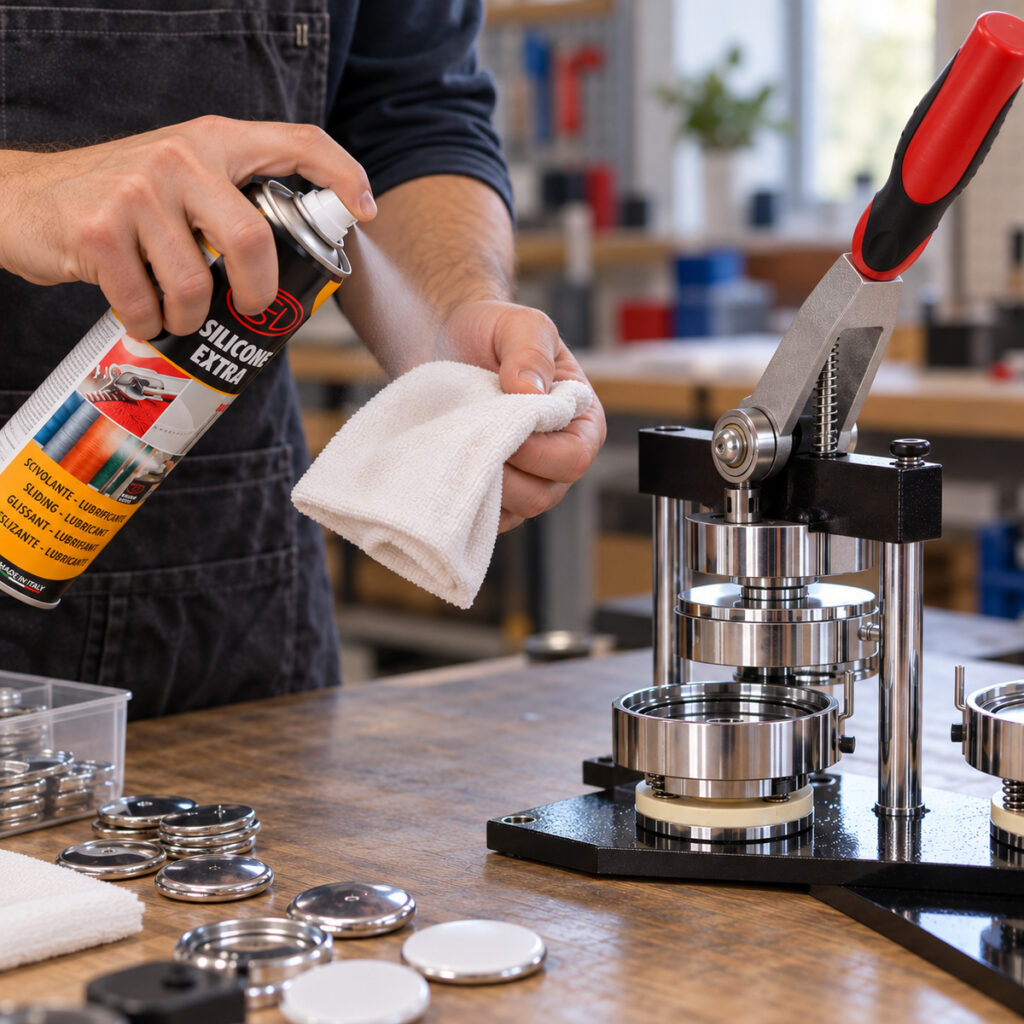
- Lever joints.
- Mobile axes.
- Turning points.
- Mechanical surfaces where you notice greater friction.
As long as they are accessible areas and their lubrication is compatible with the machine's design.
How to apply silicone spray
Before lubricating:
- Thoroughly clean the area and remove any accumulated dust or debris.
- Shake the container.
- Apply a very small amount.
- In specific areas, first spray the silicone spray onto a clean cloth and then apply the product to the piece for better control.
- Operate the lever or mechanism several times to distribute the lubricant.
- Remove any excess with a clean cloth.
Prevent the silicone from coming into contact with printed paper, the protective film, sheet metal parts, or pressing surfaces.
Should the moulds be lubricated?
As general maintenance, it is not necessary to spray silicone directly onto the moulds.
The most important thing is to keep them clean, dry, and free of debris.
The surfaces where the front, the design, the protective sheet (Mylar), and the back are placed must remain clean to avoid stains or issues during pressing.
If you notice that the fastening of the plates begins to fail, first check:
- The cleaning of the mould.
- The placement of the pieces.
- The compatibility of the consumables.
- The condition of the mould.
- The functioning of the mechanism.
Do not use lubricant on the moulds as the first solution.
How often should maintenance be performed?
There is no exact frequency that applies to all badge-making machines. It will depend on the frequency of use, the production volume, and the amount of waste generated.
As a practical rule:
- Remove the residue after each work session.
- Conduct a more comprehensive review periodically.
- If you use the machine intensively, inspect it more frequently.
- Lubricate only when a moving part offers more resistance or has lost smoothness of movement.
It is not necessary to use silicone every time you clean the machine. Before lubricating, always check that the problem is not simply caused by accumulated dirt.
What to check if the badges start coming out poorly
If a metal sheet is not properly closed, it does not necessarily mean there is a fault.
Before working on the machine, check:
- The moulds: ensure there are no remnants of paper, plastic, or dirt that could interfere during pressing.
- Consumables: all parts must match the size and type of installed mould. Do not mix components of different sizes.
- Assembly order: typically, the metal front is placed first along with the printed design and the protective sheet. The back is added during the second pressing.
- The thickness of the paper: paper that is too thick may make it difficult to close some badge models. Use the recommended weight for the badges and moulds you are using.
- Position of the pieces: ensure that both the front and back are fully seated within the mould before lowering the lever.
What to do if the lever is stiffer than usual?
If you notice that the lever or the base offers more resistance than before:
- Do not force the mechanism.
- Check that there are no incorrectly placed pieces.
- Remove any possible debris from the base and the moving parts.
- Clean the accessible joints and pivot points.
- Check that the mechanism moves freely.
- Apply a small amount of lubricant to the moving parts if necessary.
- Operate the lever several times or rotate the base to distribute it.
- Remove any excess and test the movement again without mounting any sheet metal.
If the resistance persists or a blockage occurs, avoid continuing to use the machine until the cause is identified.
Forcing the lever or the base can damage the mechanism or the moulds.
Conduct a test after maintenance.
Before returning to a long production:
- Operate the lever several times without material.
- Check the movement of the base.
- Ensure there is no lubricant near the moulds.
- Manufacture one or two test badges.
- Check the closure and the finish.
If everything is working correctly, you can continue with the usual production.
Mistakes to avoid during maintenance
To avoid damaging the machine:
- Do not use large amounts of lubricant.
- Do not spray silicone on the consumables.
- Do not lubricate the moulds indiscriminately.
- Do not use metal tools to scrape the moulds.
- Do not force the lever.
- Do not disassemble internal mechanisms unless necessary.
- Do not use abrasive products on pressing surfaces.
- Do not let paper and plastic waste accumulate for long periods.
Proper maintenance extends the lifespan of your machine.
Spending a few minutes periodically cleaning and checking your badge-making machine can make a difference in the long run. Keeping the moulds free of debris, checking the condition of moving parts, and lubricating only when necessary helps maintain smooth and precise operation.
In addition to reducing the risk of jams, wear, or issues during pressing, proper maintenance helps to extend the lifespan of the badge-making machine and maintain more consistent results in each production.
A simple routine of cleaning and inspection can prevent minor breakdowns, reduce work stoppages, and help you get the most out of your machine for a longer period.
Frequently asked questions about the maintenance of a badge-making machine
How to clean a badge-making machine? Remove any paper, plastic, and dust residues with a clean, dry cloth. Pay special attention to cleaning the moulds, the base, and the areas near the mechanism.
Can I use spray silicone on a badge-making machine? Yes, it can be used in small amounts to lubricate certain moving parts and reduce friction. Avoid getting it on the moulds, designs, and consumables.
Do the moulds of a badge-making machine need lubrication? As regular maintenance, no. The moulds should primarily be kept clean, dry, and free from debris.
How often should a badge-making machine be cleaned? It depends on the frequency of use. It is advisable to remove debris after each use and conduct more thorough periodic inspections.
Why is the lever of my badge-making machine stiff? It could be due to dirt, misaligned parts, or increased friction in a joint. First, clean the machine and check the mechanism before applying lubricant.
How do I know if my badge-making machine needs lubrication? If a moving part starts to offer more resistance than usual after cleaning, it may be advisable to apply a small amount of lubricant to that point.
If you have any questions, share them with us in the comments. Our team will be delighted to provide you with answers and assistance. You can also contact our Customer Service department directly for further help.
Remember that on our social media channels, we daily share a wealth of ideas, offers, and the latest news related to various personalisation techniques. To stay updated with everything, follow us on Instagram and TikTok. And don't forget to subscribe to our YouTube channel to continue learning with us!
See you in the next post!
👇 Other articles that may be of interest to you:
🦾 How to produce more badges effortlessly with an automatic badge machine?

🔵 Custom badges: how to make them, ideas and tips
WE WANT TO KNOW WHAT YOU THINK
You may also like