



What compressor do I need for my pneumatic heat press?
What compressor do I need for my pneumatic heat press?
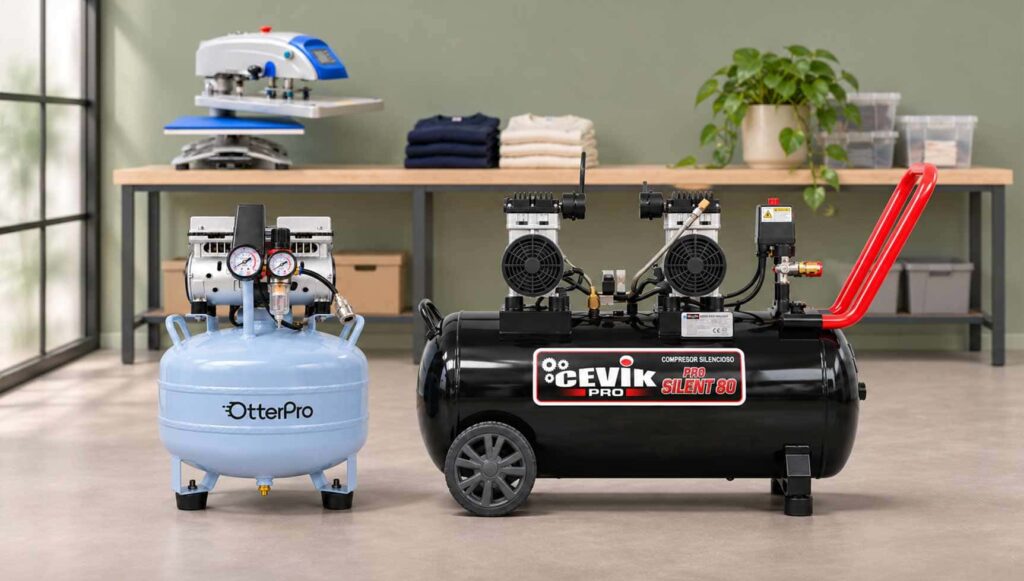
The perfect combination for professional customisation
The compressor you need for your pneumatic heat press is one that exceeds its maximum pressure and keeps up with your work pace without running out of air. To choose correctly, pay attention to four factors: pressure, flow rate, tank capacity, and noise level. We explain what to look for in each one.
ÍNDICE
Do all heat presses require a compressor?
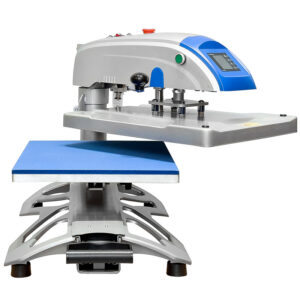
Only the pneumatic ones. They use compressed air to close, open, and apply constant and precise pressure on each piece. The manual presses and the automatic electric ones operate without it.
And an important notice: the compressor does not come with the iron, it is purchased separately.
Are you still deciding which heat press to buy? Start with Which heat press should I buy?. Would you rather know which one suits your technique best? Check out the best heat press for each technique.
Four factors to consider before buying a compressor
To choose correctly, check four things: that it reaches the pressure required by your heat press, that it has sufficient flow for your work pace, that the tank is suitable, and that its noise and maintenance fit your workshop.
Pressure (bar / PSI)
It is the force with which the compressor can push the air. The rule is simple: its maximum pressure must exceed what your iron requires, so it doesn't always operate at its limit. Then, you adjust the working pressure with the regulator, so there's no need to use the maximum.
Example: the Brildor XH-B1N pneumatic press of 40x50 cm has a maximum pressure of 5 bar. An 8 bar compressor is more than sufficient.
What to check: the maximum pressure of your press in its technical specifications and ensure that the compressor comfortably exceeds it. (Useful equivalence: 1 bar is approximately 14.5 PSI.)
Air flow rate (L/min)
A pneumatic press does not continuously consume air: it uses air each time the plate lowers and raises. Therefore, for a normal pace, a large compressor is not necessary.
Another thing is if you spend the day pressing one piece after another. In that case, you need the compressor to recover air quickly, meaning more flow rate.
Tank capacity (litres)
The air receiver or tank stores the compressed air.
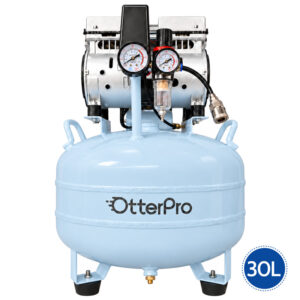
- Small (24 to 30 L): compact and lightweight. Ideal if you have limited space or work in batches.
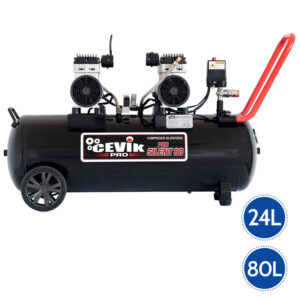
- Large (80 L): more air reserve and fewer motor starts. Just what you need for intensive work sessions.
Noise level (dB)
Noise matters, especially if you are going to iron in front of clients: a noisy compressor can be annoying and make conversation difficult. If you work in a workshop or a separate production area, it becomes less important. Always check the decibel level on the technical specifications sheet.
Transport and location
Consider where you will place it and if you will need to move it. Some models come with wheels, which makes transportation easier.
Basic maintenance to extend the life of your compressor
Investing in a good air compressor also means taking proper care of it to avoid unpleasant surprises during production:
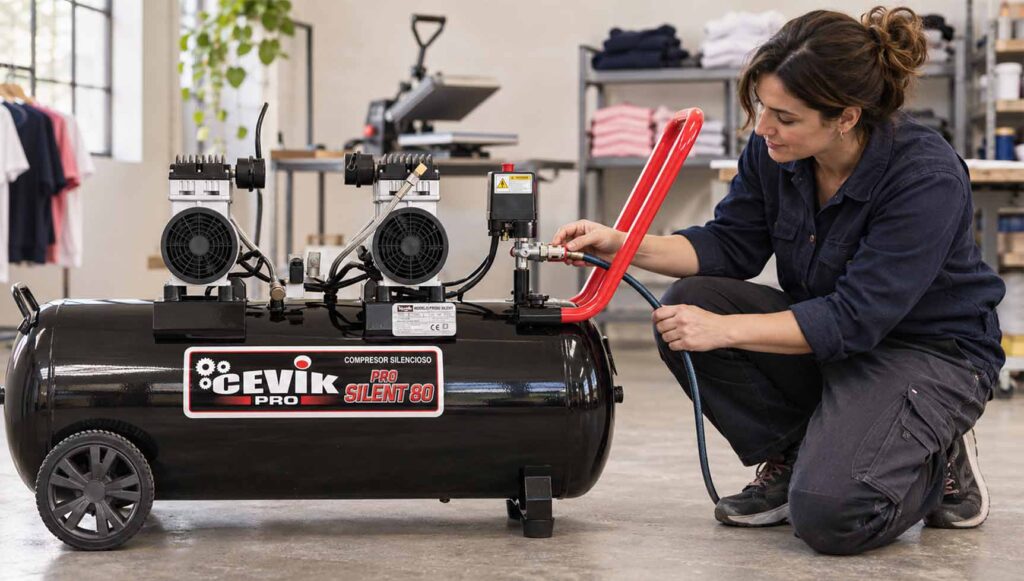
- Drain the water from the air tank: Due to condensation, compressed air generates moisture inside the tank. It is essential to regularly open the bottom drain valve to expel the accumulated water and prevent internal rusting.
- Empty the filter container if your compressor includes one.
- Check connections and tubing for leaks.
- Check the air filters: An environment with vinyl dust, transfer paper scraps, or textile particles can block the air intake. Clean or replace the filters periodically.
Frequently Asked Questions
What compressor do I need for a pneumatic heat press? You need one with a maximum pressure that exceeds your press's requirements and provides sufficient flow rate and tank capacity for your work pace. If you are pressing in front of customers, also check the noise level.
Do all heat presses require a compressor? No, only the pneumatic ones. Manual and electric automatic presses operate without a compressor.
Is the compressor included with the pneumatic heat press? Generally, no: it is sold separately. For example, the Brildor XH-B1N 40x50 cm pneumatic heat press requires a compressor and does not include it.
What pressure does a pneumatic heat press require? It depends on the model, so check the maximum pressure in its technical specifications. Choose a compressor whose maximum pressure comfortably exceeds this, and then adjust the working pressure with the regulator.
How many litres of tank does the compressor need? It depends on your work pace. A small tank (24 to 30 L) is sufficient for intermittent runs; for intensive production, a large one (80 L) is advisable, as it provides more air reserve and starts less frequently.
How much airflow is needed? A moderate airflow is usually sufficient for a normal pace, as the press only uses air when the plate goes down and up. If you are pressing continuously, you will need more airflow so that the compressor can quickly replenish the air. Compare the airflow (L/min) with the recommendations from your press's manufacturer.
What is needed to connect the compressor to the press? You need a compressed air hose and a connector compatible with the compressor's outlet and the press's inlet. Check the diameter and type of connection before placing the order. Brildor compressors use an 8 mm connector and an 8 mm hose, which are purchased separately.
How often should the compressor be drained? At least once a week, and more frequently if your workshop is humid or you work long hours. Draining removes condensation water from the tank and prevents it from rusting inside. Always follow the instructions in your model's manual.
Can I have the compressor where I attend to clients? Yes, as long as you choose one with low noise. Check the decibels (dB) in the technical specifications before purchasing.
Can I connect two pneumatic presses to the same compressor? Yes, as long as the compressor can meet the combined demand and maintain the pressure required by each press when both are in use. If you alternate the pressing, consider how the cycles are distributed throughout the batch.
Why does the pressure drop when I do several presses in a row? One possible cause is that the press uses air faster than the compressor can replenish it. The tank covers part of this demand, but if the reserve is depleted during production, the pressure drops until the compressor recovers. Check if the drop coincides with the more frequent cycles, if there is water accumulated in the tank (purging it restores useful volume), and if there are leaks in the tube or connections.
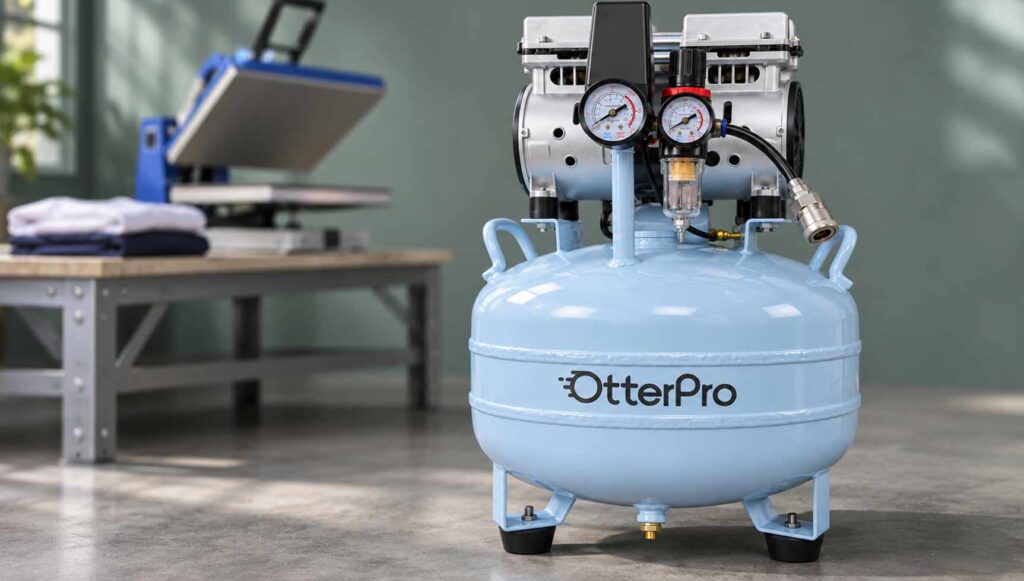
Having trouble with your heat press and compressor combination? Take a look at the Pro Silent and OtterPro compressors, or seek advice from our team. You can contact our Customer Service department directly for assistance.
Remember that on our social media, we daily share a wealth of ideas, offers, and the latest updates related to various personalisation techniques. To stay updated on everything, follow us on Instagram and TikTok. And don't forget to subscribe to our YouTube channel to keep learning with us!
See you in the next post!
👇 Other articles that may be of interest to you:
🆕 What is the xTool WonderPress and why is it not a conventional transfer press?

⚖️ Heat press vs domestic iron: Which should I choose?

🧼 How to keep your transfer press in good condition
🔥xTool Heat Press 3 in 1: the essential tool for versatile customisations
WE WANT TO KNOW WHAT YOU THINK
You may also like