


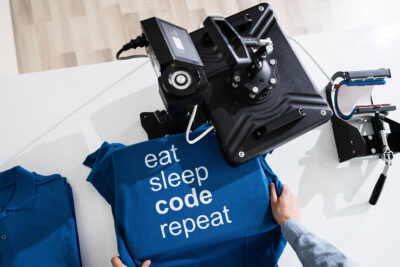
⚖️ Heat press vs domestic iron: Which should I choose?
⚖️ Heat press vs domestic iron: Which should I choose?
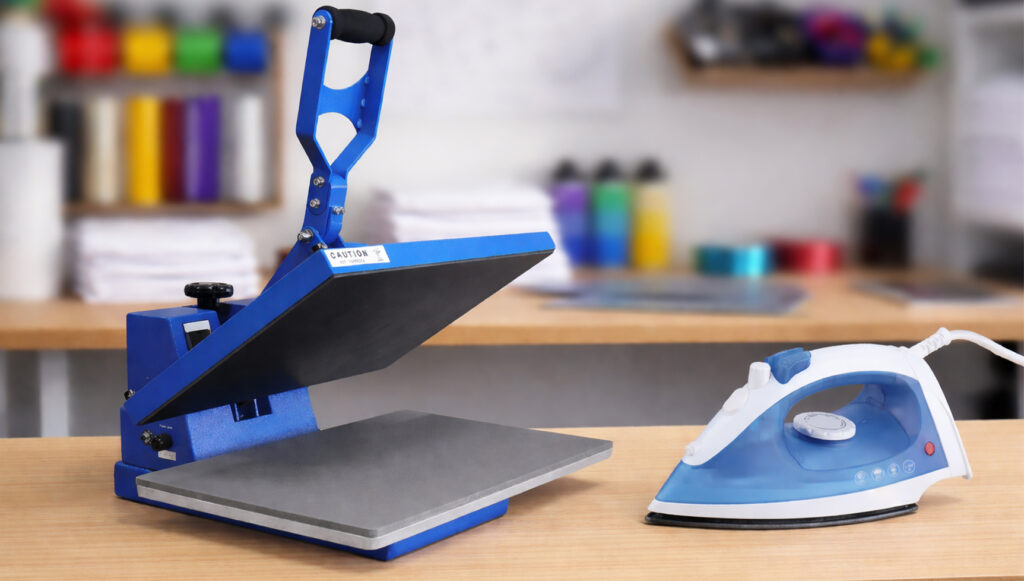
When starting in the world of customisation, it's common to wonder whether it's worth investing in a professional heat press or if a domestic iron will suffice. At first glance, both apply heat, but in practice, they do not operate the same way nor do they offer the same results.
In this article, we clearly and straightforwardly explain why a domestic iron is not the best option for personalisation and what a heat press really offers when you are looking for durable and professional finishes.
ÍNDICE
What do we understand by professional heat press?
A transfer press (or heat press) is a machine specifically designed for customisation tasks that require controlled heat and pressure. It is commonly used in techniques such as heat transfer vinyl, sublimation, transfer paper, or DTF.
Unlike a regular clothes iron, a professional one is designed to operate consistently, precisely, and safely, even during continuous production.
The differences that truly make a difference
Stable and homogeneous temperature
One of the key aspects of a professional heat press is that it maintains a uniform temperature across the entire surface. This is crucial for ensuring that the vinyl or ink activates correctly throughout the entire design.
In a domestic iron, the heat is not distributed evenly: there are hotter areas and cooler ones, which can lead to incomplete transfers or uneven results.
Actual (and adjustable) pressure
Pressure is not a minor detail: it is one of the factors that most influence the durability of the work.A professional heat press allows you to adjust the pressure according to the material and technique, ensuring that the design adheres correctly.
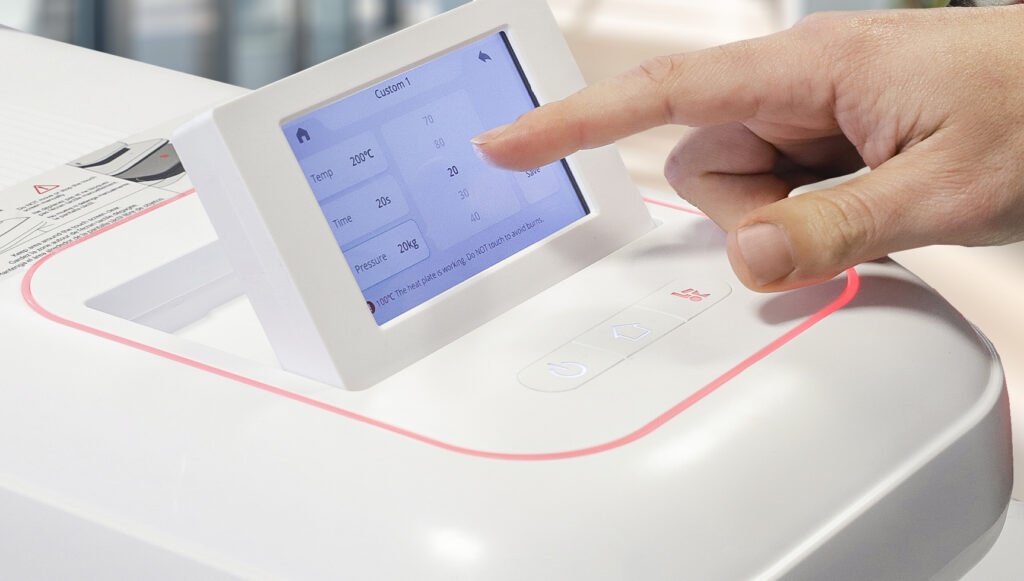
In the case of digital heat presses, you can easily adjust and control both the pressure and the temperature.
With a domestic iron, the pressure depends solely on the force you apply with your hand, making it very difficult to replicate results or work consistently.
Work surface designed for customisation
The professional heat presses feature wide bases that allow the design to be applied in one go, without shifting or overlapping.
In contrast, a domestic iron requires working in sections, increasing the risk of marks, design shifts, or poorly fixed areas.

Why a domestic iron falls short
Although it may be useful for very specific tests, a household iron has clear limitations when it comes to customisation:
- ❌ Uneven heat, especially at the edges
- ❌ Poorly controlled pressure
- ❌ Reduced ironing area
- ❌ Presence of steam, which is incompatible with most techniques as they require dry heat.
All this translates into less professional results and, above all, less durable ones.
Benefits of working with a professional heat press
More durable results
The work done with a professional heat press better withstands washing and continuous use, which is essential when selling personalised products.
Greater productivity and fewer errors
By working with stable parameters (temperature, pressure, and time), you reduce errors, repetitions, and material waste. This is key when transitioning from testing to regular production.
Versatility of applications
In addition to T-shirts, a heat press allows you to customise bags, sweatshirts, promotional textiles, and other flat products with greater control and safety.
To clearly see the differences between a domestic iron and a professional heat press, the most useful approach is to compare them point by point.
⚖️ Heat press vs domestic iron
| HEAT PRESS | DOMESTIC IRON |
| 👍Pros | 👍Pros |
| 🌡️ Precise temperature control ⏱️ Programmable time 🔧 Uniform pressure and heat 📐 Larger working surface 🧼 More durable results | 💸 Economical price 🪶 Lightweight and easy to handle 📦 Takes up little space |
| 👎Cons | 👎Cons |
| 📦 Larger size 💸 Initial investment | ❌ Manual pressure ⚠️ Inaccurate temperature and time adjustment 🌡️ Irregular heat 🧪 Less durability of the design |
If you are considering making the move to a professional heat press, the next step is to choose the model that best suits your way of working.
In this article, we explain which heat press you should buy, depending on the type of customisation, the volume of work, and the available space.
If your goal is to customise occasionally and without demanding finish, a domestic iron can suffice in a pinch. However, if you want professional results, repeatable and intended for sale, a professional heat press is your best option.
The difference lies not only in the machine but also in the control it gives you over the process and the final quality of the product.
If you have any questions, share them with us in the comments. Our team will be delighted to provide you with answers and assistance. You can also directly contact our Customer Service department for additional help.
Remember that on our social media, we post a large number of ideas, offers, and the latest news related to various personalisation techniques daily. To stay updated on everything, follow us on Instagram and TikTok. And don't forget to subscribe to our YouTube channel to continue learning with us!
See you in the next post!
👇 Other articles that may be of interest to you:
🧼 How to keep your transfer press in good condition
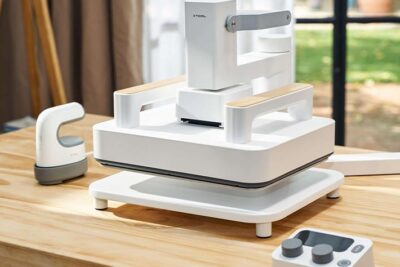
🔥xTool Heat Press 3 in 1: the essential tool for versatile customisations
☕ Which mug press to buy? A guide to choosing well from the start
WE WANT TO KNOW WHAT YOU THINK
You may also like